Dream of the Dream of the Rarebit Fiend:
An Interview with Ulrich Merkl (with Three Addendums)
 Sample page from Ulrich Merkl's Dream of the Rarebit Fiend book: imaginative imagery, impeccable restoration, immaculate design (pg. 65, "Circus, Curiosities" imagery)
[Note: If you’ve already read about, or ordered or own, Ulrich Merkl’s Dream of the Rarebit Fiend book, don’t skip this post -- a new interview with its archivist and editor awaits, just below. If you’re going to San Diego Comicon, scroll to the end of today’s post for booth info -- yes, you can check out the book yourself if you’re going to be there! If this is all new to you, read on, please!]
Now and then, a truly essential book surfaces. This is one of those, and this post is about one of these essential books.
In January of this year, fellow comics and animation fan
Miron Murcury sent a joint email to
Ulrich Merkl and myself, urging us to get in touch with each other, with
this link to Ulrich’s site in the Comic Art for Fans galleries venues.Dr. Merkl was hard at work on a new book, aiming for a March 2007 publication, and his description of the project read, quite literally, like a dream.
This dream came true -- and I urge those of you who can possibly afford the $133.00 (cost of the book and shipping; discounted if you can roust a single order for two or more copies) to order this glorious book for yourself now, today, while you can, via this website.If you’re going to San Diego Comicon this week, you can see copies there -- display copies can be browsed at Bud Plant’s and Peter Maresca’s (#2646) booths -- in any case, don’t dawdle! Once this book is out of print, it will be far dearer in price.It’s impossible to describe the magnitude and scope of the book, or the quality of
McCay’s work therein.
Rarebit Fiend was arguably the seminal comic strip of the early 1900s, the wellspring for much of what we take for granted today as cartoonists, comic readers, and in the pop culture as a whole -- regardless of where, on the creation/production/consuming food chain, you reside.
McCay’s skills and ingenuity are legend, and his draftmanship remains second to none -- simply put,
Dream of the Rarebit Fiend is one of the essential comics creations of the 20th Century, and
Ulrich’s book is the ideal showcase for the entirety of
Dream (what isn’t in print of the strips is on the bonus DVD; it’s all here, all 821 strips, and much, much more!).
 Warning: Do not drop this book on your cat!
's
Dream of the Rarebit Fiend is the precursor to all dream comics, a genre that has become central to dream research (and near and dear to the heart of one of my best friends,
Rick Veitch, whose
Rarebit Fiends series remains the high-water mark of its peculiar but remarkable genre). But there’s so much more to say --
McCay single-handedly invented and refined many devices the entire comics medium relies upon to this day; it’s almost impossible to find a basic storytelling, graphic or sequential panel tool
McCay did not invent, refine or put to use in the
Rarebit canon.
Dream of the Rarebit Fiend also introduced many visual narrative conceits and concepts all 20th and 21st Century visual media utilize.
For almost 20 years, via my
Journeys Into Fear slide lecture series, I’ve discussed and illustrated a number of
McCay Rarebit Fiend innovations that resonate through the horror genre, including first-person ‘point of view’ comics narratives. Many of these remain primal experiences revisited in the reading of
Ulrich’s
Rarebit Fiend collection, and this alone makes this book an essential volume for any media scholar’s library.
 The historic beginning of the 'ever-growing creature' archetype in the 20th Century: McCay's delightful distillation of mythic monsters threatening for their unchecked growth in this March 8, 1905 installment ofRarebit Fiend inspired his 1921 animated film The Pet. As Ulrich notes, this may have also been inspired by one of Edward Lear's illustrations in the 1870 The Book of Nonsense.
Note this scan is not from Ulrich's book, but rather a pre-restoration-process scan; the version printed in the book is much sharper. (1921),
McCay introduced the entire 'giant monster attacks metropolitan city' genre, predating Willis O’Brien’s spectacle of a Brontosaurus [sic] attacking London for the climax of The Lost World (1925; in the source novel, Conan Doyle only had Professor Challenger’s specimen pterodactyls fly the coop into the London skies).] Hello, Dali!: The September 26, 1908 Rarebit Fiend anticipated Salvador Dali's "Soft self portrait with fried bacon," 1941, and the cosmetic surgeries of Terry Gilliam's Brazil (Merkl, pg. 55)
he final specs of
Ulrich’s
Dream of the Rarebit Fiend volume are indeed impressive, and having this book in my own hot little hands, I can personally confirm them all to be true:
Hardcover, handbound
464 pages (139 in color)
Illustrations: 1010 (219 in color, 791 in black & white)
Dimensions: 17 x 12 x 1.2 inches / 43,5 x 31 x 3 cm (large horizontal format)
Weight: 9 1⁄2 pounds / 4,3 kg
Language: English
Cover price: Euros 89.00 / $ 114.00
Why so expensive? Read
Addendum I, below, after our interview, covering
Dr. Merkl’s initial response to FAQs, for the hows and whys of that -- and then
order your copy now, while the very limited supply lasts. At the time I ordered the book two weeks ago, there were only about 700 copies left. Don’t wait!
Again, here's Dr. Merkl's website, the only place to order this limited edition beauty.I have already seen to it that a copy
now resides in
The Schulz Library at
The Center for Cartoon Studies, and am shipping a copy to
Lea Ann Alexander and her associates at the
HUIE Library at
Henderson State University, as part of the
Stephen R. Bissette Special Collection. This ensures comics creators, scholars and researchers some measure of future access to this rare tome after it goes out of print.
I urge any relatively wealthy Myrant readers to consider purchasing and donating a copy or copies to your local libraries while supplies last (impressing upon any library accepting the donation the scarcity, uniqueness and value of the book, and some assurance it will remain in their respective special collections and/or reserve shelves).Finally, wishing to find out more, I proposed an interview exchange with
Ulrich, who graciously rose to the challenge. Here’s our conversation -- hardly the last word on his stunning project, but hopefully enough to sweeten the dreams and reading of
McCay and comics lovers everywhere...
________
 'Silas' aka Winsor McCay at work: he had lots of ideas... (pg. 84)
 I started collecting comics and books about comics when I was 5, and I guess I saw my first
McCays when I was 10 or 12, but I didn't pay much attention to his work, because it was still too sophisticated for me. At age 20, I started attending conventions and collecting original artwork, there was the [
John] Canemaker [
Winsor McCay] biography, and suddenly I had access to the
McCay universe, both in the form of reproductions and original art. It simply blew me away, and I just couldn't believe that original artwork by this outstanding master was available at all, and then even at prices also a normal person could afford (I am referring to the year 1986). Unfortunately, I didn't buy any
McCay originals then, mainly because dealers told me they were already much too expensive...
SB: You've articulated your reasons for publishing Dream [see Addendums, below] -- but what was the specific gestalt experience that prompted your undertaking this massive publishing venture?UM: I am an art historian and archaeologist, and a book/comic book/culture/history maniac. I wrote a Ph.D. thesis about medieval book illumination (comparable to the
Rarebit book in weight and size), and during the course of the work I was totally surprised to find outstanding masterworks nobody had ever looked at before. I discovered a new world that had been buried in archives for 500 years and I learned that you can find treasures if you are digging a little bit deeper than the others.
I had always wished to see more of
McCay's work, but it was inaccessible. In 2002, when my life had turned a little bit more quiet than before, I decided to start digging. My main reasons were:
1)
McCay was one of the most talented artists of all times. While mainstream artists like
van Gogh, Monet, Klimt, Picasso, etc. etc. are reprinted again and again (and they do deserve it),
McCay, whose work is 100% the same quality, is more or less unknown among the broad public -- something I cannot accept. He, and the public, deserved a publication of his legacy.
2) TV, cinema, comics, computer games, pop music, even fine arts -- wherever you look, 90% of the production flooding us is pure shit, a big fuss about nothing, no substance, no quality, only hot hair. On the other hand,
McCay's outstanding top-quality work (and many other vintage comic strips) hidden, buried, inaccessible, and deteriorating in archives? A big unjustice! I wanted to show to people how real quality looks like, what is possible, how they are all being cheated and poisoned every day, to give them an impulse.
3) I wanted to see those strips, just for my own enrichment.
 Bungle in the Jungle: McCay's Dream of the Rarebit Fiend for March 9, 1907, anticipating Ray Bradbury's classic short story "The Veldt" (pg. 261)
 When I decided to work seriously on this project, in 2001, I started screening eBay regularly for keywords like "
Rarebit" and "
McCay". Soon after, I was lucky enough to win a large collection of original newspaper clippings, c. 400
Rarebit Fiends. This gave me the courage to continue. The next step was the purchase of 80 microfilm reels from the
New York Public Library, containing a complete run of the
New York Evening Journal from 1904 to 1913. This was the only newspaper carrying the strip from the beginning to the end, and therefore the basis for any research (mainly for the dates).
The Ohio State University contributed another c. 100 strips from their collection. Other strips were taken from printed books, from original art sales catalogs and from original artwork. I cannot exclude there might be some minor gaps, mainly in the later period, from 1911 on, when the strip appeared irregularly, but only very few. I did not find any new strip in the past four years, although I never stopped continuing my research.
 Small World, In't It?: Rarebit Fiend, Sept. 21, 1907 (pg. 292)
 I am an art historian and archaeologist, and I learned to go back to the roots, to the original sources, this being the vintage newspapers. I bought dozens of vintage newspapers, containing
McCay info or illustrations, on eBay; I took a great deal of information & images from the
New York Evening Telegram microfilms, other images from online newspaper archives, and other several important newspaper clippings were generously contributed by my Italian friend
Alfredo Castelli (who also contributed two essays to the book).
SB: Yes, Castelli's chapters are excellent! One of the facets of your book I personally found most fascinating were the links between Rarebit and subsequent pop culture creations. When, in your own experience, did you first begin to recognize the ripples from Rarebit in other media?UM: Again, I am an art historian, and we are trained for doing nothing else than searching for precursors and followers of styles and motifs. All art historians in the world are constantly asking the same questions: who did this invent, who took it up and developed it, and how? This is a fascinating sport, and when you are open-minded, when you read and watch a lot, and if you have a good visual memory, you will discover the whole culture of mankind being a sequence of developments, of evolutions, in all genres, literature, painting, film, comics, etc.
There is no use searching systematically, for example asking the question "
is there any book, film or comic containing the motifs 'somebody is attacked by squirrels', 'somebody is being fried in a skillet', and 'an elevator pops out of the top floor of a building'?" will not lead to anything if you never saw
Charlie and the Chocolate Factory. What you need is a huge image reference archive in your brain, and suddenly it makes 'click'. Browsing the
Rarebit Fiends, I had a lot of '
deja vus', and in most cases
McCay was the earlier reference.
SB: I'm curious about what was involved with clearing permissions for the images you include from key films, from L'Age d'or to Dumbo -- and what the stories are behind the images we aren't permitted to see. Were there any other materials you would have included in the book, if you could have secured permission to do so?UM: Any author writing about movies sees himself confronted with the enormous problem of obtaining film stills and reprint permissions for those stills. The first problem is: there is no major film still database, so you have to research if the film is available on DVD, you have to buy the DVD, you have to search for a tool enabling you to paste downs stills from those DVDs, that's all very time-consuming and often leads into a blind alley. The second problem: copyright owners are incredibly difficult!! They want to know everything, the reprint size, the print run, the exact context, the exact texts accompanying the image, etc... Let's take the
Walt Disney Company: it took me 1 1/2 years and 16 letters (they don't communicate via e-mail) to obtain permission for the
Disney images in my book. But -- nothing against
Disney, they only wanted to be convinced of the seriousness of my project, and they were cooperative and friendly. Other companies however are almost inaccessible.
Warner Bros., for example, unfortunately copyright owner of many important films, either do not grant reprint permission at all (for the more recent films) or, for the older films of low commercial interest, they are asking $500 per image (
Disney is 'only' asking $50!). I would have loved to reprint 16 great stills from
Tex Avery cartoons (now
Warner property), but I was unable to invest another $8,000 only for permissions. I simply cannot understand the rip-off mentality of those multi-billion companies. First: those films were produced with the intention of reaching as many people as possible, not with the intention of being hidden in a secret vault. Second: my book is no rival product to any DVD. Third: reprint in a book means free publicity for the film.
SB: Yes, I completely agree.UM: Some people are saying: "
Ah, don't bother with them, just reprint the images and nothing will happen. And if someone complains, just say it was a clear case of 'fair use'". But I didn't want the whole project being killed by some stupid little copyright violation, that wouldn't be worth it. Other films I would have loved to reprint stills from are
Hitchcock's
The Birds (
Rarebit Fiend 276+333) and
Harry Potter and the Goblet of Fire (
RF 649), but permissions were either too expensive or generally not granted. A very revealing still from
Terminator II (
RF 234) could not be included because actor
Robert Patrick did not allow the use of his likeness... If any hardcore fan out there is interested in film stills I was not allow to reprint, just send me $10 and you will receive a CD-ROM with 30 stills for your
private use.
SB: This is heady stuff, for much of what McCay introduced in Rarebit Fiend goes beyond singular images or narratives; he created entire genres, including -- most obviously -- dream comics. Were you tempted to devote more space in the book to this phenomenon?UM: Well, you will always find more when you are digging deeper and deeper, and I have enough material to fill another book, but at some point you have to say "
stop, it's enough now". I believe most readers are mainly interested in the
Rarebit strips rather than in the "scientific" or "scholarly" background info, so I limited myself to the most important aspects.
 Rarebit and Little Nemo Kith & Kin: Dreamy Mary (left, by Eddie Eksergian, 1904-1905) and The Naps of Polly Sleepyhead (by Peter Newell, 1905-1907), just two examples of the many eye-popping comic strips illustrating Alfredo Castelli's excellent chapter, "Dream Travelers, 1900-1947" (pg. 110)
 I am not sure if there are
any strips that eluded my search. Perhaps my edition
is definitive. At least, I did not find any new strip in the past four years, although I never stopped searching.
To be absolutely sure, some poor soul would have to browse all the major U.S. newspapers from 1911 to 1924, very difficult to locate, very time-consuming, very expensive...
SB: Let's consider your book definitive, then, and the last word. Were there any materials simply too degraded to restore digitally, or via any present means?UM: No, I was able to restore everything. The quality of some microfilms was quite poor, the images came out a bit blurry, you cannot do anything here, but that's all.
SB: Was your Ph.D. thesis on medieval book illumination, which you described as "comparable to the Rarebit book in weight and size," published in a form available to us?UM: Yes, it was printed, a nice little book with 589 pages, 100 images in color, 400 images in b&w, and it weighs only 7 pounds. It's in the German language, however, but the images are really beautiful, almost all of them published for the very first time, weird stuff like witches, dwarfs, people tormented in hell, like
Rarebit Dreams. It is available from Amazon Germany for Euros 126 ($174). It is also in several U.S. libraries and I was told it also appears on eBay U.S. from time to time.
SB: Well, I'm going to have to track down a copy, if only for my teaching and research work. Thanks for your time, Ulrich, and most of all thank you
for this fantastic book. Good luck in all you do!____________
Addendum I:
Everything You Wanted to Know About Dr. Merkl's Rarebit Fiend Volume, But Were Afraid to Ask
Anticipating questions about his motives, the book and the scope of the project, Ulrich circulated these statements earlier this summer. I present them here as they were presented, and as an introduction of sort to both Ulrich and his momentous book:
_________
On the production of the book:
The whole book is a one-man-show. As some of my previous publications had suffered due to indifferent editors and printers, I took the risk of monopolizing all the work myself. That meant text and image research, obtaining pictures, copyright research, image scanning, image restoration, printing, promotion, selling and shipping.The only person besides me who contributed substantially to the book was my designer, who knocked my ideas into shape.On the uniqueness of the volume, and other McCay reprint volumes:
My book does not have anything to do with Winsor McCay, Early Works I-VII and Dream of the Rarebit Fiend, The Saturdays, published by Checker Books from 2002-2006. Despite all its merits, this reprint is fairly disappointing. There is no additional information, the individual episodes are not dated, the large horizontal episodes are reproduced in a small format, a lot of illustrations are of disastrous quality, and many episodes are completely missing.The work on my book began in 2001, two years before the first volume of this reprint was published. Its shortcomings made me determined to continue my project, despite the loss of exclusiveness. Unfortunately, this cheap reprint satisfied the demand of many potential buyers of my book.I did not use any images from this reprint (which would have saved me several thousand hours of restoration work), but took everything from my own sources (original newspaper clippings, original artwork, and, for thegaps, microfilm).Without the Checker reprint, my book would have been the first reprint for over 600 out of 821 strips, now only 300 are presented exclusively in my book. The Statue of Liberty: Skating on thin ice, Rarebit Fiend for June 30, 1906 (pg. 228)
Errata: On typos in The Dream of The Rarebit Fiend volume [suggestion: save and print to insert into your copy of the book]:
Although me and many friends worked through the galleys again and again, the printed book revealed a couple of minor mistakes we all overlooked. Some examples:- p. 61: The Chicago Examinator should read Examiner, of course- p. 74: several copies have a line of nonsense text on bottom left, under the red image (we eliminated this during the course of the printing)- p. 117: caption for "Chilly Cholly": the series ran from May 26, 1911 to October 29, 1911 (not from October 29 to May 26)- p. 120: Primo Carnera died in 1967, not in 1947- p. 127: the image on bottom right is from episode #266, not from #226- p. 432: the Joan Steiner image is printed too dark- p. 437: President Taft is printed too darkOn reproduction size, printing, binding and the book’s format:
Reproducing the large horizontal strips to their original published size required an unusually large and horizontal book format. When I started working on the project, I did not at all consider this being a problem.During the course of the work I learned that a book of this size and shape cannot be bound automatically, therefore requiring handbinding. Handbinding being incredibly expensive in Europe (c. $90.00 per copy), I was lucky to find somebody in Egypt to take over this work. Binding in Egypt meant also printing in (because it is impossible to ship tons of printed paper to
EgyptEgypt without damage), so I spent a week in Cairo supervising the printing process. The handbinding makes each copy a unique piece of superb craftsmanship.
 A Rarebit Fiend meets Washington and Eliza: crossing the river, July 9, 1911 (pg. 410)
On pricing and the print run:
We produced a total of 1,000 copies. I would rather have made more (1,500 or 2,000, resulting in a lower price per copy), but paying everything from my own (my bank's) money, this would have been too big an investment for me. I invested a total of $90.000 into this book (+ 6000 working hours).Euros 89.00 / $ 114.00 sounds much, but the book is actually cheap, considering that- there were only 1,000 copies printed- 464 of the oversized pages correspond to 928 large, respectively 1856 normal pages- 144 pages are printed in color (the most expensive part of the production)- the book contains over 1,000 illustrations (1/2 of them reprinted for the first time ever)- it is handbound (one of the most expensive aspects of book production).I was only able to offer the book at such a low price because I did all the scanning and image restoration work by my own (6000 working hours all together), because bookbinders' wages in Egypt are low, and because I amdoing all the advertising and distribution by my own, thus avoiding the wholesalers' 50-60 % percentage.If I had realized this project the regular way, involving a professional graphic studio for the scans, a publishing house, local printers and bookbinders, and using the usual distribution channels, we would have had to ask over $400.00 for a single copy (rather than $114.00) just to cover the costs.And I am even offering attractive bulk discounts. (Note to U.S. buyers: unfortunately, the book was produced in the Euro zone, and the $ exchange rate is unfavorable now. Four years ago, I could have offered the book for $68.00 instead of $114.00, obtaining the same Euro amount, but the exchange rate is something beyond my control.)On the DVD accompanying the book:
It contains high resolution scans (8 or 3 MB each) of all 821 episodes known to exist (including 452 strips not reprinted in the book), a 600 page WORD file with a catalogue raisonné of all episodes, containing avast array of additional information about the individual episodes, the printed text of the book (which can be browsed by using keywords), and an animated film by Winsor McCay, all together more than twice the image and text material printed in the book._______
Addendum II:
Ulrich’s original announcement read as follows:
_______
DREAM OF THE RAREBIT FIEND is a comic strip published in American newspapers from 1904 to 1913.Each episode presents the dream of some poor soul who had the misfortune of partaking of Welsh Rarebit (a melted cheese toast) before retiring, a decision that results in unusual and fantastic dreams. In the last panel, the dreaming victim awakens, vowing never to partake of Rarebit before bedtime again.The strip was written and drawn by Winsor McCay (1867–1934), famous for his Little Nemo in Slumberland.Other than Little Nemo, which was addressed to children and mainly lived from its spectacular layouts, DREAM OF THE RAREBIT FIEND focuses on the plots, seen from a decidedly adult point of view, and is devoted to adult nightmares and phobias, making it one of the weirdest, absurdest, most amazing and shocking comic strips of all times, simply “the most bizarre newspaper feature in American history” (Jeet Heer). Star Power, circa 1906: Among the many remarkable contents not listed in the announcement or press release is "Prominent Personalities," Dr. Merkl's exhaustive indexing of the celebrities of the day featured in various Rarebit Fiend dream adventures (pg. 80)
 [And] a DVD with- high resolution scans (8 or 3 MB each) of all 821 episodes known to exist- a 500 page WORD file with a catalogue raisonné of all episodes, containing a vast array of information about the individual episodes, including chronological strip numbering, original publication dates, later reprints, whereabouts of the original artwork, inspirations used by Winsor McCay, later quotations taken from this strip, historical background information etc.Apart from the strip’s fascinating content and outstanding graphic qualities, DREAM OF THE RAREBIT FIEND is also an important source of information about everyday culture in the United States during the early 20th century, as it was here (and only here) that Winsor McCay incorporated real daily life in almost every episode – from fashion, sport, politics, work, architecture, technical progress through to prominent personalities, so much so that one can virtually speak of an encyclopedia, or a mirror on the United States in the early 20th century.It is easy to identify all the people, events and objects mentioned in the book, as the enclosed DVD contains the printed text as well as the complete catalog of episodes in the form of a WORD document, which can be browsed by using keywords.
_______
Addendum III (and final):
The Press release:
Unlike other cheap reprints that flooded the market recently, churned out quickly and produced without any editorial care, my book has been carefully researched, written and produced, choosing always the best (and most expensive) solution in every aspect of the production:I invested 3000 hours of my time into research work and another 4000 hours into digital image restoration. Simply because I am admiring Winsor McCay’s genius and because I saw there was a treasure to be raised.Whenever possible, the scans were taken from original artwork and from original newspaper clippings collected over the years. Microfilms (the principal base of most other reprints) were only used to fill gaps. July 6, 1911 Rarebit: cartoonists snagging ideas; Winsor McCay, Tom E. Powers (pg. 409)
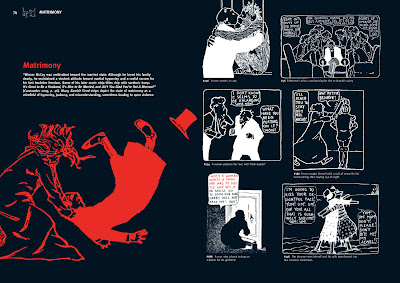 "Matrimony": marital distress & discord, Rarebit Fiend style (pg. 74)
_______
That's it -- I'll add illustrations to this post throughout the day, but this is the best push I could provide for Ulrich's handsome tome. There's nothing in this for me, and it's rare I lavish this kind of attention on a book, but believe me, it's worth it!
Have a great Monday, one and all!
Labels: Dr Ulrich Merkl, Dream of the Rarebit Fiend, Winsor McCay
 Two of Winsor McCay's post-Dream of the Rarebit Fiend strips, It Was Only a Dream, circa 1911; another page sample from Ulrich Merkl's definitive Dream of the Rarebit Fiend volume (pg. 454)
 In the realm of must-have books of 2007, you all know I rate the upcoming Tim Lucas biography Mario Bava: All the Colors of the Dark highest of all, right alongside Ulrich Merkl's Rarebit Fiend collection.


